The first time we get called back to a landscape lighting install we didn’t do, it’s usually February. The homeowner’s path lights are dark, the transformer is buried under a snow plow’s pile of slush, and one of the connections has corroded at the splice. They want to know if we can fix it. We almost always can, but the conversation about why it failed in the first place is the more useful one.
Chicago is hard on outdoor lighting. We get road salt blown into yards, freeze and thaw cycles, snow plows that don’t respect the lawn boundary, and aerators every spring that find buried wire even when it’s marked. Half of our outdoor lighting work is correcting installs from contractors who don’t account for any of that. The other half is doing it right the first time.
Here’s how we think about a Chicago landscape lighting project that actually lasts.
Low-voltage vs line-voltage
Most residential outdoor lighting in this market is low-voltage, 12 to 15 volt systems run off a transformer that steps down from a regular 120-volt circuit at the house. Low-voltage is the right answer for path lights, garden uplights, downlights from soffits, deck step lights, and most decorative work.
Line-voltage, full 120-volt outdoor circuits, comes into play for floodlights on a garage, motion-sensor security lights, gazebo or pergola lighting that needs to drive heavier fixtures, and pool deck lighting where the local code requires it.
The trade-offs:
Low-voltage is safer to work around, doesn’t require conduit for the wire runs once you’re past the transformer, and uses smaller fixtures with cleaner aesthetics. The downside is voltage drop on long runs, which means the lights at the far end of a 100-foot run will be dimmer than the ones near the transformer if the wire isn’t sized correctly.
Line-voltage handles longer runs without voltage drop concerns and powers brighter fixtures, but requires conduit, GFCI protection, and a permit. The fixtures are bulkier.
We design most landscape lighting jobs as low-voltage, with line-voltage added only where the fixture or the local code requires it.
Where contractors mess up the transformer
The transformer is the part of a low-voltage system that fails first if it’s installed wrong, and it’s the part most contractors put in the wrong place.
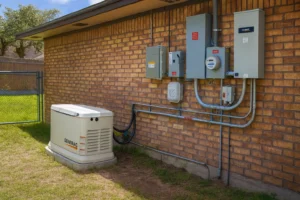
The transformer needs to be mounted on an exterior wall, off the ground, in a location that gets airflow and isn’t directly hit by a sprinkler head or a downspout. We usually mount near the meter, on a side wall the homeowner doesn’t see from the front, with a service loop in the wire so it can be replaced without disturbing the runs.
Transformers should be sized for the load with at least 20% headroom for future fixture additions. A 300-watt transformer driving 280 watts of fixtures is a transformer that’ll fail or run hot. We size to 75% of nameplate capacity at most.
The transformer is also where most photocells and timers live. Modern installs use either an astronomical timer that adjusts to seasonal sunset times, or a smart-home controller through Lutron or a comparable system. The old-school photocell that gets snowed over and stays on for three days in February is a service call we’d rather not be making.
Wire gauge matters
For low-voltage runs, the temptation is to run 14-gauge for everything because it’s cheap. The reality is that wire gauge has to match the run length and the load.
A short run, under 50 feet, with low-wattage LED fixtures, can hold on 14-gauge. A long run with multiple fixtures, especially if it’s an uplighting install with several 5 to 8-watt LED uplights along a 150-foot run, needs 12 or 10-gauge to avoid noticeable dimming at the end. We’ve corrected installs in Wilmette and Hinsdale where every fixture beyond the second one was visibly dimmer because the contractor ran 14 across the whole yard.
Wire connections matter as much as wire gauge. Outdoor splices need to be made with waterproof connectors rated for direct burial, and the connection itself should sit in a small junction box, not just be buried under mulch. Buried splices fail. They always fail eventually. The question is whether they fail in year two or year ten, and the difference is the connector quality.
The fixture choice
The fixtures that survive Chicago winters tend to share a few qualities.
Solid brass, copper, or stainless steel housings. The painted aluminum fixtures that come with cheap kits show their age within two seasons. Salt and freeze-thaw eat the paint, then the metal pits.
Sealed LED modules, not replaceable bulbs. Replaceable bulb fixtures look more flexible but the socket is the failure point in outdoor exposure.
Stake-mounted path lights that have a real base, not just a thin rod that bends when the lawn crew goes by. We’ve replaced more bent path lights than I’d like to admit.
The brands we install most often have warranties that cover ten years or more on the housing and at least five on the LED. If the warranty is two years, that’s the manufacturer telling you what they expect.
Permits and code
Low-voltage landscape lighting work generally doesn’t require a permit, since the transformer is plug-in or hard-wired into an existing exterior receptacle.
Anything that involves running new line-voltage circuits, adding a new exterior receptacle, or pool-area lighting absolutely requires a permit. The pool work has its own bonding and grounding requirements that are worth a separate conversation.
The City of Chicago and most of the suburbs treat new exterior receptacles as a permitted scope. We pull the permit and schedule the inspection.
Smart controls without the headache
Most homeowners want to schedule their outdoor lights, not flip a switch every evening. The options:
A simple astronomical timer at the transformer. Set it once, it adjusts itself for the year. Reliable, no app required, no Wi-Fi dependence.
A Lutron Caseta or RA3 system that ties the outdoor circuit into the same control system as the rest of the house. We do these often. Comes with the benefit that if the homeowner is out of town, the lights still come on at sunset and they can override from anywhere.
A Wi-Fi-only smart switch. Works fine when the Wi-Fi works. We don’t recommend it as the primary control for landscape lighting because the system loses functionality every time the router reboots or the cloud service has an outage. It can layer on top of a Lutron or astronomical timer as a convenience, not as the primary.
What a thoughtful design looks like
Landscape lighting that looks good in Chicago tends to be quieter than what most kits sell.
Down-lighting from a soffit or a tree casts moonlight-style fill across a yard. It’s subtle, beautiful, and rarely overdone.
Path lights spaced 8 to 10 feet apart, not 4. Closer spacing reads as runway lighting, not residential.
Uplights on architectural features, the chimney, columns, a feature tree, do more for curb appeal than rows of generic path lights.
Deck step lights that wash light down across the tread. They make the deck safer at night and don’t blind anyone walking up.
Less is generally more. We’ve come behind installs with 60 fixtures across a half-acre lot that the homeowners hated and asked us to disconnect half of.
Cost reality
We don’t quote landscape lighting off square footage. We quote off the design, the fixture count, the wire runs, and any line-voltage work. A small front-yard install with a transformer, 8 path lights, and 2 uplights, all low-voltage, lands in a different price bracket than a full property job with 30 fixtures, multiple zones, smart control, and a new line-voltage circuit for floodlights.
We’d rather walk the property with you than give a phone estimate. The walkthrough is also where we figure out where the existing receptacle is, where the transformer should sit, and where the wire runs can go without conflicting with sprinklers, gas lines, or future landscaping.
Work with a licensed Chicago electrician
Whether you want path lights along a driveway in Naperville, uplighting on a Logan Square two-flat, or a full landscape lighting design with smart control, Star Victory Electric has been handling residential, commercial, and industrial electrical work across Chicagoland since 1992. We pull permits where they’re required, install fixtures that hold up to Chicago weather, and design systems that look right at night, not just in the catalog. Licensed, bonded, and insured. Request a walkthrough at starvictoryelectric.com or call (773) 234-0172.