The generator question has gotten more common since the August storms a few years back left parts of the northwest suburbs without power for three and four days. Homeowners who’d been considering a standby finally pulled the trigger, and most of them came to us with the same first question: should it run on natural gas or propane?
The answer depends on what’s on your property today, where it’s going long term, and how much continuous run time matters to you. Both fuels work. The trade-offs are real, and a few of them aren’t obvious until you’ve installed enough of these.
How a standby generator actually works
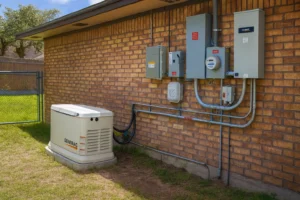
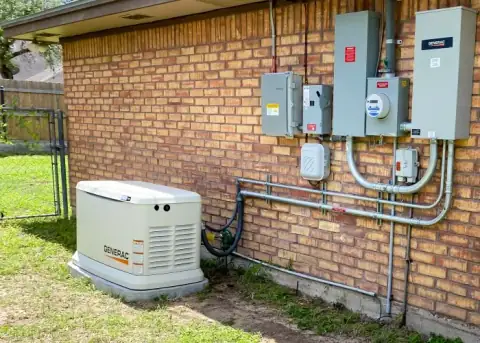
A whole-home standby is a fixed unit that sits next to the house, wired into a transfer switch tied to the panel. When ComEd drops, the unit senses the loss, fires up, and the transfer switch shifts your house from utility power to generator power within 10 to 30 seconds depending on the unit. When utility comes back, it shifts you back and shuts the generator down.
The fuel source dictates two things: how long it can run, and how much output you actually get from the nameplate rating.
Natural gas: the default if you have it
If you already have natural gas service to the house, NG is almost always the answer.
The fuel supply is continuous. There’s no tank to refill, no truck to schedule, no monitoring of fuel level. As long as the gas main is feeding your house, the generator can run. We have NG generators in Naperville and Schaumburg that have run 60 hours straight through extended outages without anyone touching them.
The fuel cost per kilowatt-hour generated is generally lower in this market than propane, especially if you’re running long outages.
The install footprint is smaller. No tank, no underground excavation for a buried propane tank, no clearance requirements for a tank in the yard. The generator pad and the gas line tap, plus the electrical work, is the whole job.
The trade-off is real but specific: an NG generator delivers about 10% less output than the same nameplate unit running on propane, because natural gas has lower BTU per cubic foot. So a 22-kilowatt generator on natural gas is effectively about a 20-kilowatt generator. We size accordingly. If your load calc says you need 22kW of usable output, we install a 24kW NG unit, not a 22kW.
The other trade-off, which is rare but worth naming, is that natural gas service can be interrupted in extreme conditions. A major main break or a regional pressure drop can take your gas down at the same time as your power. We’ve seen this exactly twice in Chicago in the last decade, both during deep cold snaps. For homeowners who consider that risk unacceptable, propane removes it.
Propane: when it’s the right call
Propane makes sense in a few specific situations.
Your property doesn’t have natural gas service at all. This is more common in unincorporated parts of Lake, Kane, and Will counties than people expect. The cost to bring NG to a property that doesn’t have it is often higher than the difference of installing a propane setup.
You’re running a property where continuous off-grid resilience matters more than fuel cost. A vacation home in Wisconsin Dells, a horse farm in Kane County, a property where you can’t tolerate any chance of fuel interruption. Propane gives you a self-contained fuel supply.
You want maximum nameplate output without uprating. Propane delivers about 10% more output than NG on the same generator. So if you’re at the edge of a generator sizing tier, propane keeps you in the smaller, cheaper unit.
What people underestimate about propane is the tank logistics. A 500-gallon tank, which is the typical size for a standby covering a 3,000-square-foot home, holds enough fuel to run a 22kW unit at 50% load for around three to four days. Once it’s empty, you need a delivery, and during a regional power outage, propane delivery is also harder to schedule. Some homeowners size up to a 1,000-gallon tank for that reason. Bigger tank, bigger pad, bigger up-front cost.
Cold weather is also worth noting. Propane vaporizes more slowly at very low temperatures. In Chicago winters, the tank’s vaporization rate matters as much as its capacity. We size both the tank and the regulator for sub-zero performance, because a generator that can’t draw fuel fast enough at minus-five doesn’t help you.
Generator sizing matters more than fuel choice
I’d rather have a properly sized propane generator than an undersized NG one, and the same is true the other way around.
Sizing is about how much load your house actually pulls during an outage. Not the total connected load. The simultaneous load you’d want to keep running. We do a load calc on every install. The questions:
What absolutely needs to stay on? Refrigerators, freezers, sump pumps in basement-prone neighborhoods like Forest Park and Berwyn, the furnace blower or the boiler circulator, lights, internet, and at least one bedroom AC.
What would you like to keep on? Central AC, an EV charger, the kitchen, a home office.
What’s nice to have if there’s room? Hot tub, second AC, a dryer.
The answer drives the generator size. A typical Chicago single-family on natural gas with central AC, gas heat, and standard kitchen lands at a 22 to 26 kilowatt unit. A larger house with electric resistance backup, two EVs, or a hot tub starts at 32 kilowatts and goes up.
We size for the load, then pick the fuel. Not the other way around.
What the install actually involves
A typical standby install runs three to five days on site once permits are pulled.
Day one is the pad, the conduit, and the rough plumbing. Day two is the generator set, the transfer switch, and the panel work. Day three is gas line tie-in or propane tank set, commissioning, and inspection prep. Days four and five, if needed, are inspection and any callouts.
The permit is a real one. So is the gas inspection, separate from the electrical inspection. We coordinate both. ComEd doesn’t need to be involved unless the install triggers a service upgrade.
Our default recommendation
For a Chicago-area home that already has natural gas, the default is a properly sized NG standby. The fuel logistics are the strongest argument we have, and most homeowners aren’t expecting outages long enough or extreme enough to justify the propane trade-offs.
For homes without NG service, propane is the obvious answer, and we size the tank for the climate and the load.
For commercial sites, hospitals, dental offices, animal hospitals, retail with refrigeration, the calculation is different. There, fuel redundancy and run time often justify dual-fuel setups, but that’s a conversation we’d rather have on a walkthrough.
Work with a licensed Chicago electrician
Whether you’re sizing a standby for your home, a clinic, or a commercial site, Star Victory Electric has been handling generator installations across Chicagoland since 1992. We pull the electrical and gas permits, coordinate the inspections, and size the unit against the actual load, not just the square footage. Licensed, bonded, and insured. Request a quote or schedule a walkthrough at starvictoryelectric.com or call (773) 234-0172.