The question we get most from Chicago homeowners is whether their existing 100-amp service is enough, or whether they should upgrade to 200. The honest answer almost never comes from looking at the panel itself. It comes from looking at what you’re going to run.
I’ll save you the technical lecture. Service amperage is the maximum amount of current the utility’s drop can deliver to your house at any one time. A 100-amp service can deliver, in theory, 24,000 watts at 240 volts. A 200-amp service can deliver double that. The question is whether 24,000 watts is enough headroom for the way you actually live.
For most Chicago homes built before 1980, the answer used to be yes. For most Chicago homes today, the answer is increasingly no.
What changed
Three things have changed the load profile of an average house since 100-amp service became the default.
Air conditioning got bigger and more common. A two-and-a-half-ton condenser pulls around 25 to 30 amps on startup. A central system in a 2,000-square-foot bungalow plus a window unit upstairs is real load.
Kitchens added dedicated circuits. An induction range pulls 40 to 50 amps. A microwave on its own circuit is another 15. A dishwasher is another 12 to 15. A garbage disposal is another 8 to 10. None of those existed as required dedicated circuits when most 100-amp services were sized.
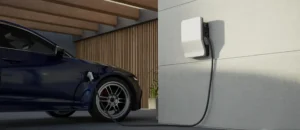
Then came EV charging and electrification of heating. A Level 2 EV charger is 30 to 60 amps continuous. A heat pump in cold-climate Chicago configurations pulls 30 to 50 amps. Add either of those to a 100-amp service that’s already running a modern kitchen and central AC, and you’re not in the headroom zone anymore. You’re past it.
When 100-amp service is still fine
There are houses where a 100-amp panel is still appropriate, and we don’t push an upgrade just to push one.
A small condo or townhome with gas heat, gas range, gas dryer, gas water heater, no central AC or only one window unit, no EV, no plans to add any of those. That panel is sized for that life. We’ve signed off on plenty of them in Lincoln Park and Lakeview.
A historic two-flat in Logan Square or Wicker Park where the upstairs unit and downstairs unit each have their own 100-amp panel. That’s effectively 200 amps of capacity divided across the building, and as long as neither unit is running an EV or heat pump, that often holds.
A weekend or rental property running a refrigerator, lights, and not much else.
In all of these cases, 100-amp is the right answer. The right answer depends on what’s behind the panel cover and how the house is used, not on what’s fashionable.
When 200-amp is the right call
200-amp service starts making sense when the load math no longer leaves headroom for one more dedicated circuit. The general rule we run for clients in Cook and DuPage County:
A house with central AC and an electric range, but gas heat and gas water heater, can usually survive on 100 amps. Survive isn’t the same as comfortable.
A house with central AC, electric range, electric dryer, and a hot tub starts to push the limit on 100 amps and is comfortably 200.
Any house where you plan to add a Level 2 EV charger should be 200-amp at minimum. Two EVs, or one EV plus a heat pump, may need to be 320 or 400 amps split into two 200-amp panels.
A new addition that adds bedrooms, a kitchen island, or a finished basement almost always tips a 100-amp house into needing 200.
If you’re remodeling and the GC is asking, the default answer in 2026 is 200. The cost difference between rough-in for a 100 and a 200 in new construction is a fraction of what it costs to come back and upgrade later.
The thing people confuse: service vs panel
A 100-amp panel and 100-amp service are not the same thing.
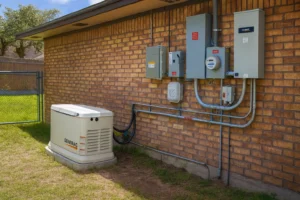
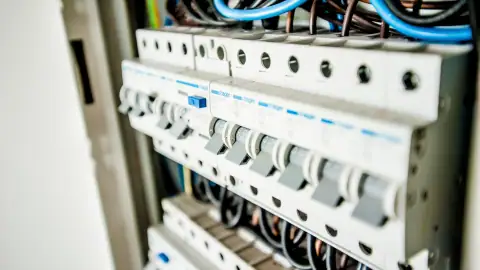
The service is what ComEd delivers, and it’s defined by the meter base, the service entrance conductors, and the main breaker. The panel is the box on your basement wall that distributes those amps into branch circuits.
We’ve seen Chicago homeowners get talked into a “panel upgrade” that just swapped the box on the wall and left the 100-amp service intact. They paid for a new panel and got the same maximum capacity. If your goal is to run more load, the work has to include the meter base, the service entrance, and the main breaker. ComEd has to be looped in for the disconnect and reconnect. Otherwise you’ve upgraded the symptoms, not the cause.
When we quote a service upgrade, we’re quoting all of it: the new meter base, the SEU or SER conductors, the main breaker, the panel, the bonding and grounding, the permit, and the ComEd coordination.
What it tends to take in Chicago
A 100 to 200 amp service upgrade in a single-family Chicago home, with the panel in a reasonable basement location, generally takes a day for the install and another day in calendar time for ComEd’s reconnect. The meter is pulled mid-morning. Power is back by late afternoon. We do the upgrade with the inspection scheduled in advance so the AHJ shows up the same day or the next.
Two-flats are more involved because of the meter pan stack. Older brick bungalows can be slower because of mast work where the service comes through the soffit. Plaster walls add labor anywhere we have to fish.
Specific pricing on a service upgrade depends on the meter base location, the panel location, the conductor run length, and what the AHJ requires for grounding electrodes. We’d rather quote you off a walkthrough than off a phone description, because we’ve seen the same nominal upgrade quote come in 40% off in either direction depending on what the basement actually looks like.
How to decide
If you’re considering an EV, a heat pump, or any major kitchen remodel, plan for 200-amp service now and do the upgrade once. Doing it twice is the expensive path.
If you’re not adding any of those, you don’t have flickering or tripping issues, and your existing panel isn’t a Federal Pacific or a Zinsco, you may be fine for another decade. Don’t fix what isn’t broken.
If you’re not sure whether your current panel can hold what you’re planning to add, that’s a load calculation, and it takes about 20 minutes on site to run.
Work with a licensed Chicago electrician
Whether you need a service upgrade, a panel replacement, or just an honest load calculation, Star Victory Electric has been handling residential, commercial, and industrial electrical work across Chicagoland since 1992. Licensed, bonded, and insured. We pull every permit and coordinate the ComEd reconnect on your behalf. Request a quote or schedule a walkthrough at starvictoryelectric.com or call (773) 234-0172.